I took a trip to Tulum again, during a recent visit to Mexico, after a gap of 35 years, a journey down memory lane, to see how tourism development had evolved in the intervening years. Like other sites visited and revisited over the years—Machu Picchu, Sigiriya, most notably—these places have gone from sparsely visited, unkempt, and littered hideouts to expensive, hyped, and sanitized money pits for the local and national economies.
Tulum is no different. What was once an assembly of crumbled stone buildings and foundations infested with undergrowth, which tourists climbed over carelessly, dislodging more stones, today we see clean and restored structures retaining their original shapes, often with the help of metal supports; no climbing is permitted, and tourists have to stick to established and underbrush-free walking paths. There is a visitor’s centre, and electric shuttles transport us on the one-kilometre-long journey to the site. The proliferation of tourist shops is astonishing. The prices are astonishing too – CDN $25 for a bar of Mexican chocolate? No thanks!
At its height, the Mayan civilization spread from the Yucatán to El Salvador. Unlike their Aztec brothers in the north, who flamed out after a mere 250 years, the Mayan Empire lasted for over 3000 years, reaching its apex around 900 CE, when internecine wars, droughts (climate change), and deforestation (sound familiar?) led to the decline. And this, of a civilization famous for hieroglyphic writing, astronomy, and accurate calendar systems.
The wars may have arisen due to the decentralized power structure of the Mayans: independent city states with a “divine king,” each vying for power over neighbours; complex bureaucracies of nobles and priests; a justice system of appointed officials; mandatory obedience to the ruling class – familiar now, eh? After the “fall” in 900 CE, the empire shrank and power moved upward from southern cities like Tikal to northern ones like Chichen Itza, before the Spaniards drove the last nail into the Mayan coffin in the 16th century, when Cortés and his boys arrived for the gold (crypto was yet to be born).
Today’s guardians of Tulum—apart from the Guardia Nacional, which is prominent in many places due to the recent eruption of drug cartel warfare—are the iguanas. These speckled creatures are everywhere. They often strike affected poses for the tourist’s camera; sometimes they block your path on the walkway and survey you with a look that seems to say: “Gringo, you are just visiting, we own this place now.” Then they waddle off, slowly.
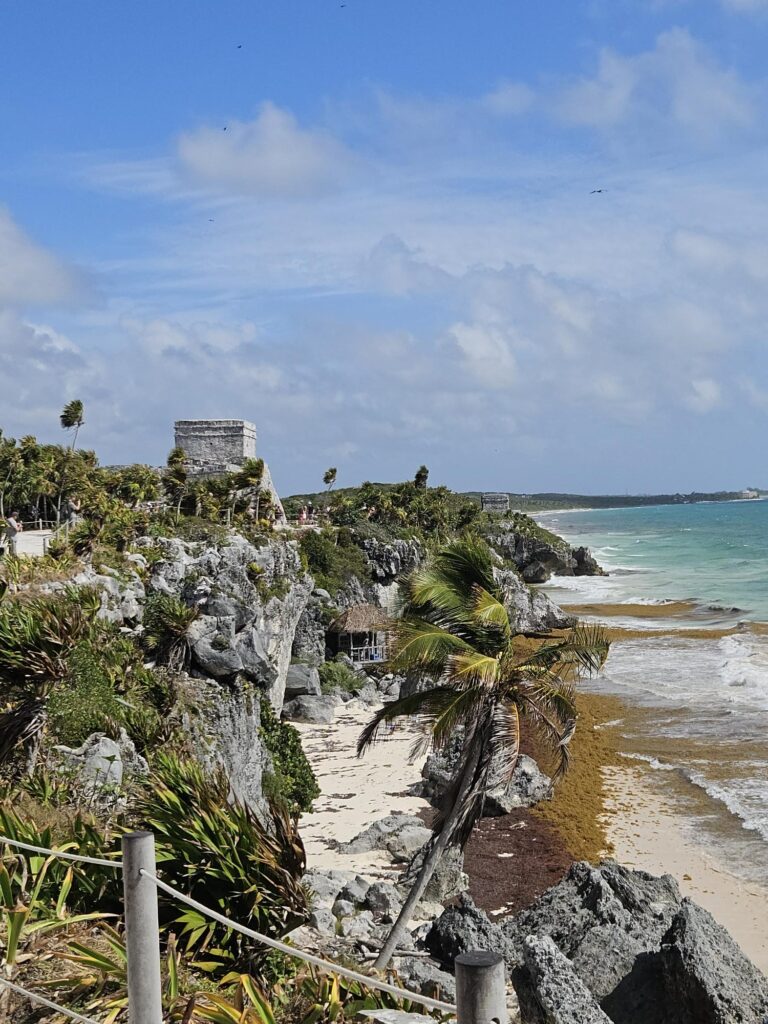
Tulum was a port during ancient Mayan times. The strategic positioning of its principal temple, El Castillo, on the cliffs overlooking the Gulf of Mexico (or is that the Gulf of America now? Hegemonic battles never end, it seems) and the play of sunlight through its windows gave ship navigators a pathway through the encircling coral reef to safe harbour. At night or during low visibility, torches were stationed in those windows.
Standing on the cliffs, watching a pelican circling above, ready to plunge into the surf and peck out its unsuspecting victim, I reflected on political power structures that have risen and fallen between Mayan times and today. Nothing much has changed. The Mayans practiced “Might is Right” among themselves, a political philosophy embraced around the world and that endured its inevitable “falls” whenever a faster gun arrived in town, until the catastrophic destruction of WWII brought everyone to their senses and “Might for Right” became popular for the next 80 years. Now, after the “rupture,” we are slipping back to those bad habits of yore that seem hard-coded into our DNA. Remnants of the “Might for Right” group are frantically embracing the new philosophy of “Variable Geography,” in which like-minded nations that agree on some things, not everything, can cooperate within those narrow areas of commonality. They hope for some restoration of those magical 80 years recently lost.
Time will tell whether this new political philosophy will lead to a more peaceful and prosperous world and keep “Might is Right” at bay. If not, the fate that befell the Mayans will be sure to repeat itself. Why don’t we learn from history? That is, if anyone is reading history these days. For those who prefer not to read, I recommend a visit to Tulum, where the evidence of its “fall” is on full display amidst the ruins.